Saniya Anjum/Bengaluru
Dr. Shaista Yusuf does not fit into a single definition. Poet. Novelist. Translator. Entrepreneur. Stage artist. Social reformer, a business woman. Each identity overlaps, strengthens and sharpens the other. Her life reads less like a layered narrative—much like her own novel Sadiyon Ka Raqs.
Born in Mumbai (then Bombay), to a family rooted in Hyderabad and later settled in Bengaluru, she grew up in an educated and value-driven khandan—respected both from her paternal side and her in-laws.
Her father, Abdulrahman Contractor, was a well-known name in the Mumbai industry. Ahe didn't inherit literature as a dynastic DNA; she cultivated. In the 7th standard, she wrote her first poem. By the 10th standard, she was married to Imtiyaz Yusuf, a car dealer and architect from Bombay. The responsibilities of early marriage did not silence her; these matured the poet in her.
 Sadiyon Ka Raqs unveiled by Dr. Shaista Yusuf at AMU
She began writing in 1970. Speaking of that turning point, she says, “Ek waqt aisa aaya jab mujhe mehsoos hua ke meri awaaz pahunchni chahiye. (A time came when I felt my voice should reach out to the larger world)”. That realization became the foundation of a lifelong literary journey.
Her academic path reflects intellectual depth: M.A. in Philosophy and Psychology, M.A. in Urdu from Bengaluru University (1984), Diploma in Cosmetology, and later an Honorary Doctorate and LL.D (Honoris Causa) from Tumkur University for her extraordinary contribution to Urdu literature and social work.
She wrote exams during pregnancy, managed home and ambition together, and treated both as responsibilities, not obstacles.
 The cover of Sadiyon Ka Raqs by Dr. Shaista Yusuf.
Her literary canvas is rich and diverse. Gul-e-Khudro, Sooni Parchaiyan, and Aab-e-Aina established her poetic identity. Sooni Parchaiyan won her several awards and secured her place among serious Urdu poets. Its formal launch was by Shamsur Rahman Faruqi in the hall of Bengaluru University—a moment of great literary validation.
The title Gul-e-Khudro became prophetic when the legendary Qurratulain Hyder described her as a “Gul-e-Khudro” — a wildflower that blooms without formal literary lineage. It was both praise and recognition of her self-made stature. The same towering figure advised her, “Mushairon mein zaya ho jaogi, (It will go waste if only recited in poetic symposiums)” guiding her to focus on sustained literary contribution rather than fleeting applause.
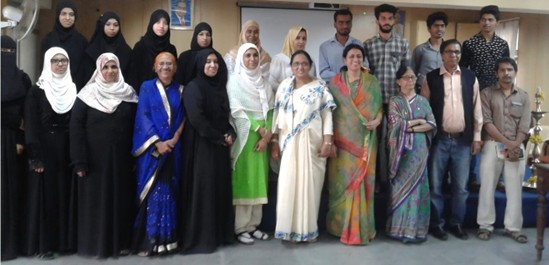 Shaista Yusuf with colleagues
Her circle of literary interaction reflects the depth of her engagement. She met and exchanged verses with Nida Fazli. She also met the renowned Akhtar ul Iman, who appreciated the poetry he read in Saughat.
She was in conversation with thinkers like Baqar Mehdi and the intense and tragic poetic voice Sara Shagufta. She even wrote a nazm on “ladki ka cigarette peena,” a subject unconventional and daring, approached from a woman’s perspective.
Despite being based in Bengaluru, she observes with a hint of surprise, “Mujhe hairat he ke Delhi aur Bombay mein zyada log mujhe pahchante hain, Bengaluru se zyada. (I am surprised to realise that more people know me in Delhi and Mumbai than in Bengaluru).”
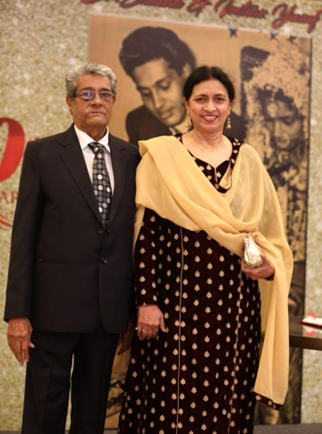 Shaista Yusuf
Her prose is equally delectable. She authored a monograph on Mahmood Ayaz, and her translation of Tales of Tomorrow as Aane Wale Kal Ki Kahaniyan brought Indian English writers’ stories into Urdu readership.
Her novel Sadiyon Ka Raqs, published by Rekhta Publications, is considered one of her most ambitious works, its characters mostly fictional yet grounded in lived realities. The novel explores the movement of time, society and consciousness across centuries, reflecting her philosophical training.
Her engagement with the performing arts added another dimension. She worked as a drama stage artist with IPTA, performed in plays of Khwaja Ahmad Abbas, and was associated with theatre circles connected to Kader Khan. A college award winner, she also cleared an audition in Bengaluru and worked with Radio Bombay for two years. The stage gave her projection; radio gave her voice discipline; literature gave her permanence.
 When poetry meets poetry — Dr. Shaista Yusuf with Javed Akhtar.
Her story does not pause at poetry readings and book launches. Through Diwan Chacha, the brother of her father-in-law, Zaheer Lashkarwala, a well-known personality—she entered the beauty industry and founded Mystic Herbal Cosmetics.
The family’s well-known Grocery shop on Avenue Road in Bengaluru is run by her brother’s children. Her son later improvised and rebranded Mystic Herbal as Clarice.
She launched ventures like Shaista’s Qubani Ka Meetha and the health product Uroojam. On balancing enterprise and emotion, she says, “Business dimaag se chalta hai, shayari dil se.” In that single line lies her dual mastery.
Her commitment to Urdu moved from personal writing to collective responsibility. She first worked as trustee with Khaleel Mamoon’s All India Urdu Trust. She is also Founder Trustee of the International Sufi World Trust, where Sayed Liyaqat Peeran serves as President.
Eventually, determined to build something of her own, she founded “Mehfil-e-Nisa” in 2012 along with Zubaida Begum, Haleema Firdous, Mahnoor Zamani, and Fareeda Rahmathulla. The organization focuses on the cause of Urdu, women and heritage. It adopted government schools, conducted competitions at elementary levels, organized Yaum-e-Urdu rallies, initially begun hesitantly but later turning into high-energy public events, and worked toward measurable improvement in educational quality.
She has always insisted on maintaining standards; if something was not at par, she chose not to continue it.
Her institutional presence extends further. She has been associated with the Karnataka Urdu Academy (2024–2026), the National Council for Promotion of Urdu Language in Delhi, and the Sahitya Akademi. She is Founder Member and Treasurer of All India Urdu Manch and connected with the United Council for Education.
Her works are included in Karnataka board syllabi, ensuring her voice reaches classrooms across the state. She frequently appears on television panels and literary juries representing Urdu literature and philosophy.
Her contributions have not gone unnoticed. Apart from the Karnataka Urdu Academy Award for Gul-e-Khudro (2010), and the multiple prestigious awards received for Sooni Parchaiyan, she has also been honored by various cultural and educational institutions, including recognition from the Aryan Institute for her lifelong dedication to Urdu and education.
What makes her journey compelling is not just achievement, but continuity. From a schoolgirl poet in the 7th standard to a novelist presenting Sadiyon Ka Raqs in Bengaluru; from early marriage in Bombay to intellectual recognition across Delhi and beyond; from poetry collections like Gul-e-Khudro and Sooni Parchaiyan to entrepreneurship in Mystic Herbal and Clarice; from stage performances to founding Mehfil-e-Nisa, each phase strengthens the other.
READ MORE: Sarvath Adil Khan's mission of reigniting the dreams of school dropouts
Her life illustrates that literature and livelihood need not be opposing forces. Philosophy and commerce can coexist. Tradition can adapt without fading. And a voice, once discovered, need not ever be silenced.