 Aditi Bhaduri
The ongoing protests in Pakistan-occupied Kashmir (POK) have taken many Indians by surprise. they shouldn't really have. Anyone with even a cursory knowledge of the place would have known these protests were long in the making. That they didn't occur earlier should be the surprise.
It was almost a decade ago that I drove into Muzaffarabad, the capital of POK, which Pakistan calls Azad Jammu and Kashmir (AJK). But there was nothing Azad about it.
To begin with, the entire territory carries only a sliver of Kashmir; only 4 per cent of the people speak the language. The majority of people in POK, as also in Muzaffarabad, are not ethnic Kashmiris, but Paharis, Punjabis and other assorted communities.
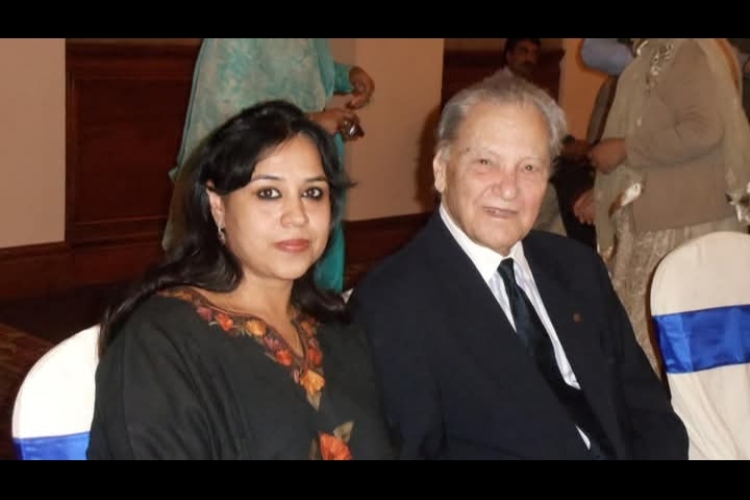 The author with Justice (retd) Javaid Iqbal, son of poet Allama Iqbal in Muzaffarabad
Nevertheless, it was breathtakingly beautiful as we drove into Kohala, travelling along the Jhelum River. The mountains and valleys spread out under a clear blue sky dotted with the whitest of clouds. It was November, and the pristine nature was so tranquil that it could lull one into believing that nothing could go wrong in this corner of the world.
I was part of a women's delegation that had travelled to POK on a track two mission. We were provided with heavy security cover. We received a warm welcome and excellent hospitality from our partner organisation and the civil society. Even the President of POK -- a titular and ceremonial office as all strings were pulled from Islamabad -- hosted a dinner in our honour.
Beautiful though it was, it was decades behind Indian Kashmir in development, both infrastructural and social. Our counterparts there had a ready response - the earthquake of 2005 had devastated much of the infrastructure.
However, the earthquake did not explain why Muzafarabad, the capital city since 1947, didn't have a medical or engineering college of standard. It had a university offering humanitarian disciplines and legal studies. So, most residents either moved out of Muzafarabad for higher studies after school or became lawyers to make a living in the city.
Even though the region had huge potential for hydro-power, the Mangla Dam built there generated revenue for Islamabad. All bureaucrats there were outsiders and appointed by Islamabad.
A colleague from Muzzafarabad, unusually frank, explained that the neglect of this region had prompted an armed struggle for azadi. The Mirpuris in the UK were the first to launch it. The neglect of POK had made them migrate to the UK in large numbers.
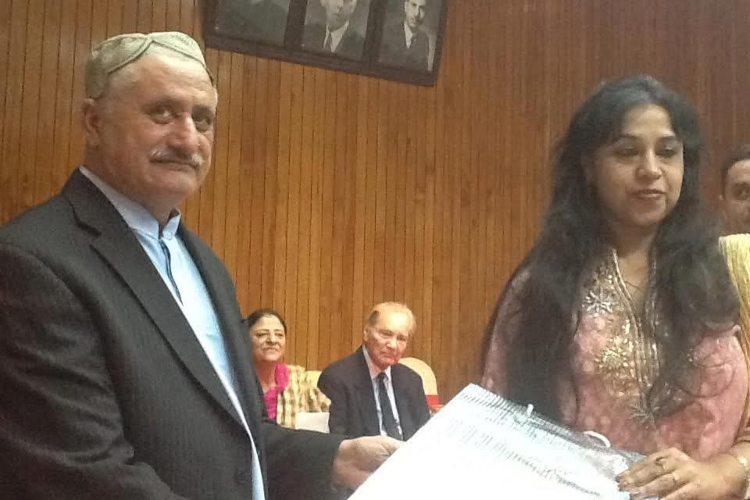 The author with President of PoJK Sardar Mohammad Yaqub Khan, in Muzaffarabad
Years had passed since the earthquake. Yet, Muzafarabad had no modern markets, cafes, restaurants, or even movie halls. We stayed in The Pearl Continental, the only five-star hotel with a bar and restaurants. Crooners belted out Bollywood numbers as the rich and privileged of the city relaxed there.
Women did not venture out alone after 2 pm, and even little girls wore the headscarf or had the dupatta wrapped over their heads, as did every adult woman I met there. It was all beautiful and medieval.
The greatest reality check, however, came when we visited Medina Market - Muzafarabad 's central market. A walled market, it was paved with shops selling all kinds of wares, mostly mundane and ordinary. The elite of Muzafarabad did not shop there; they went to Islamabad instead. One of the delegates, a young college lecturer from Srinagar, told me with awe, "My God! We are so much more advanced than here, even after losing two decades to insurgency! "
Yet, the warmth was touching. Ordinary men running their daily businesses, far removed from track two dialogues, refused to take money from us when they heard we were from India. Word had spread in the market that a group of women from India were passing through. After all, not often were so many women seen together touring the market for the first time.
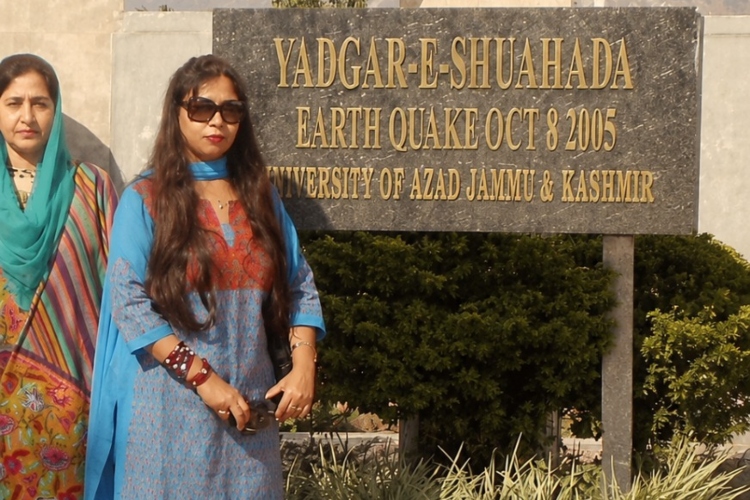 The author at the memorial for victims of 2005 Earthquake, Muzaffarabad
And soon, something interesting happened. Men began approaching us, young men, light-skinned, many of slight build. The guards accompanying us shooed them away, but they persisted.
After a while, the head of the delegation stepped aside into one of the alleyways so that the guards would not see her. She beckoned to the young man who had been following us for a while.
What did he want? To my utter surprise, he said he was from (Indian) Kashmir and had come to undertake training in arms, so that he could join the armed struggle to free Kashmir. But it had been a waste of time and effort, he confided. He was bitter about his experience and just wanted to return home to his family. He wanted our help to facilitate his return. We did not have much time to talk to him, and soon our security guard found us and hurried us to the car.
The image of the man -- sad, broken, and haunting -- stayed with me. I often wondered if he returned home.
The next day, hurrying to the hotel from an event, we were accosted by a group at the entrance- this time a group of women. Again, the security guys had a difficult time fending them off. The women were calling out to us loudly, one was even crying.
They were relatives of dissidents and disappeared people of PoK. They blamed Pakistan directly for it and appealed to us to help them. They wanted the government of India to intervene. They had heard an Indian women's delegation was in Muzafarabad and had come to meet us. They wanted to tell us about the plight of their kin who were struggling for 'azadi' from Pakistan. They had carried letters to give us to convey to the Indian government.
Our hosts were red-faced because so often in the deliberations, it was about the suffering of Kashmiris in India. This is the paradox of “Azad Kashmir”. There is no azadi, but fear. This fear had made them quiet and subservient for so long. But long pent-up, it finally had to vent. The protests seen now should have happened much earlier.
READ MORE: Trailblazing Naheed Muqueetulla reinvents Indian denim through Urbano
And finally, the day dawned for us to leave Muzzafarabad. We would travel by car back to Islamabad, and from there again by car to Attari, where we would cross over to Wagah. As we approached Kohala Bridge, graffiti appeared on both sides of the road. Much of it had images of guns. I had seen them first on the road to Muzafarabad.
I asked a colleague from POK who was travelling with me to translate it.
She read it and looked away. After a pause, she said in a low and flat voice, "These are advertisements, calling for joining the jihad."
"Against India?" I asked. She kept quiet.
Aditi Bhaduri is an independent journalist and researcher specialising in Eurasian geopolitics.

.jpg "Gujarat’s women entrepreneurs bring their craftsmanship to life during Navratri")